
Aerial Drones
Objective: The objective of this lesson is to introduce students to the world of uncrewed systems, including drones, and to explore the various types of uncrewed systems and their uses. By the end of this lesson, students should have a solid understanding of the what a drone is and the different types of drones.
Opening: Begin by reading the below lesson material about what a drone is and the different types of drones.
Discuss: Throughout this lesson, pause on certain drone types and discuss what uses you’re class would use that specific type of drone for.
The term “drone” can refer to any uncrewed vehicle that is remotely controlled or programmed to operate autonomously. In addition to the popular flying drones, there are also ground-based drones, also known as uncrewed ground vehicles (UGVs), and underwater drones, also known as uncrewed underwater vehicles (UUVs) or autonomous underwater vehicles (AUVs). These types of drones can be used for a variety of purposes, such as surveillance, exploration, search and rescue, and military operations. They typically utilize various sensors and cameras to gather data about their environment and transmit that data to a control station or computer. Some drones are also equipped with manipulators or other tools that allow them to interact with their environment in useful ways. Overall, drones represent an innovative and rapidly growing field with many exciting possibilities for the future.
Aerial Drones
Aerial drones are uncrewed aerial vehicles (UAVs) that are remotely piloted or fly autonomously using software-controlled flight plans. They are also known as unmanned aircraft systems (UAS) or uncrewed aerial systems (UAS). The terms UAV (Unmanned Aerial Vehicle) and UAS (Unmanned Aircraft System) are often used interchangeably, but UAS is a more comprehensive term that includes not only the aircraft, but also the ground-based controller, communications equipment, and other components needed to operate the system.
Aerial drones come in a variety of shapes and sizes, from small quadcopters that can fit in the palm of your hand to large fixed-wing aircraft with wingspans of several meters. They can be used for a wide range of applications, including aerial photography and videography, surveying and mapping, search and rescue operations, agriculture, delivery services, and scientific research.
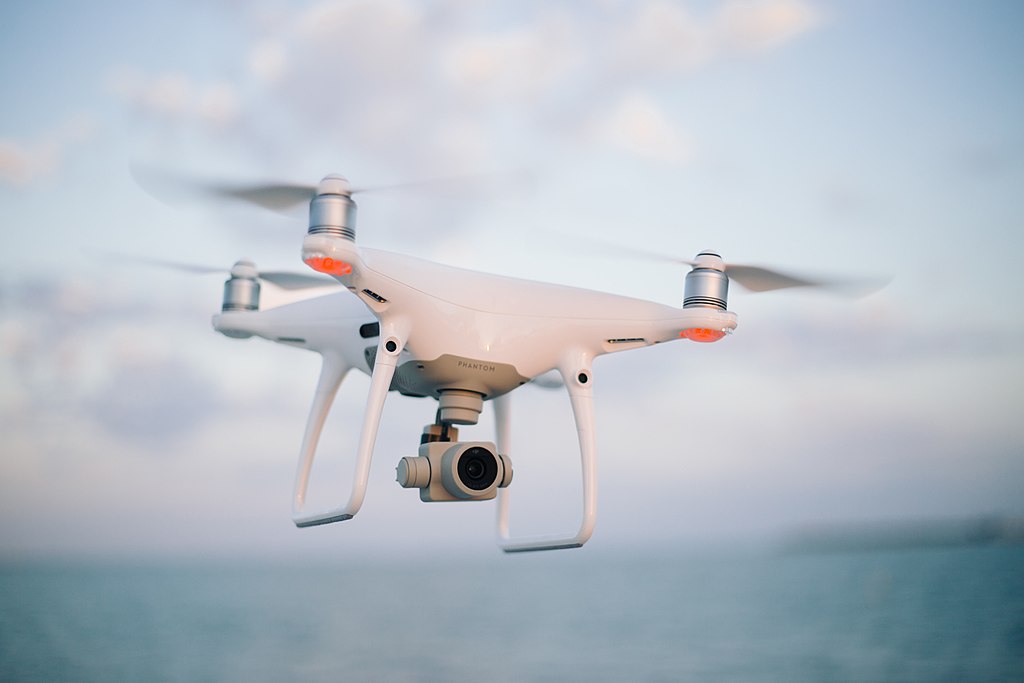

Here are some of the most common types of aerial drones:
- Multirotor drones: These are the most popular type of drone, with three or more propellers. They come in various configurations, including quadcopters (4 propellers), hexacopters (6 propellers), and octocopters (8 propellers).

2. Fixed-wing drones: These are designed to look and fly like a small airplane, with a single set of wings and a propeller in the back. They are typically used for long-distance flights and can stay aloft for hours at a time.

3. Single-rotor helicopters: These drones use a single large rotor to generate lift, along with a smaller tail rotor for stability and control. They are commonly used for industrial and military applications.

4. Hybrid drones: These drones combine the vertical takeoff and landing capabilities of multirotor drones with the speed and efficiency of fixed-wing drones.

5. Nano drones: These are the smallest and lightest type of drone, often small enough to fit in the palm of your hand. They are typically used for indoor flying and close-range aerial photography.

6. Drone Swarms: A drone swarm is a group of unmanned aerial vehicles that work together in a coordinated manner to achieve a common goal.

7. Solar-powered drones: These drones are powered by solar panels and are typically used for long-distance flights and to gather data over large areas.

8. Gas-powered drones: These drones are powered by gasoline engines and are commonly used for industrial and military applications that require long flights and heavy payloads.

9. Payload-carrying drones: These drones are designed to carry heavy payloads, such as cameras or sensors, or cargo and are used in a variety of industries for data collection and delivery.

10. Racing drones: These drones are designed for high-speed racing and maneuverability, and often feature a small, lightweight frame and powerful motors.
